
This post contains affiliate links. If you purchase through them, I may earn a commission at no additional cost to you.
And exactly what to say, politely, professionally, and without burning the whole thing down, when they try anyway.
Most employees have no idea what their actual rights are. Not because they are not smart. Because nobody explains this stuff in a way that is actually useful. HR gives you a handbook. Legal gives you disclaimers. Nobody gives you a script for Monday morning.
So here it is.
A quick note before we start: employment law varies by state and country. This is general information, not legal advice. If you are dealing with a serious situation, talk to an employment attorney. Many offer free consultations.
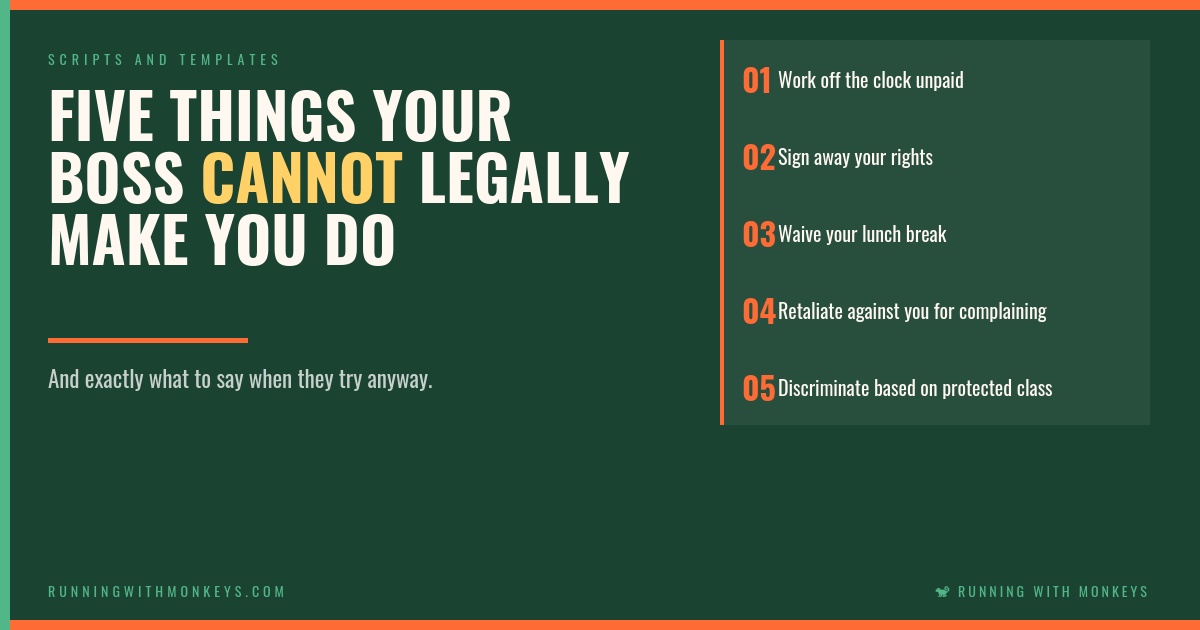
1. Work Off the Clock Without Pay
If you are a non-exempt employee in the United States, your employer is required under the Fair Labor Standards Act to pay you for every hour you work. That includes the thirty minutes you spend answering emails after dinner, the time you spend on a call before your shift technically starts, and the lunch break where you ended up in a meeting anyway.
Your boss cannot tell you that “it just needs to get done” as a way of getting around overtime laws. They can require the work. They cannot require you to do it without pay.
What to say:
“Happy to take care of that. I will log the additional hours. Can you confirm this is approved overtime, or should I adjust something else in my schedule this week to stay within hours?”
This is polite. It is professional. And it puts the decision back in their hands in a way that creates a record.
2. Work Through Mandatory Breaks
Most states have laws that require breaks for non-exempt employees, particularly for shifts of a certain length. A thirty-minute unpaid meal break is not a perk. In many states, it is the law.
Even in states with weaker break laws, forcing employees to work through breaks while clocking out for them is wage theft.
What to say:
“I want to make sure I am handling this correctly. If I need to work through my break, should I keep my time logged so I stay compliant with labor requirements? I do not want to create any issues.”
Again, you are not arguing. You are asking a clarifying question that makes the real issue very clear.
3. Violate Their Own Safety
If you work in an environment covered by OSHA regulations and your employer asks you to do something that creates an imminent danger, you have the right to refuse. This is not just workplace policy. It is federal law.
OSHA also protects you from retaliation if you report unsafe conditions. Your employer cannot fire you, demote you, cut your pay, or reassign you as punishment for raising a legitimate safety concern.
What to say:
“I want to flag a concern before we proceed. I am not comfortable with [specific condition] from a safety standpoint. Can we look at alternatives, or do you want me to escalate this through the proper channels?”
4. Discriminate Based on Protected Characteristics
Your employer cannot legally make employment decisions, set working conditions, or subject you to a hostile work environment based on your race, color, religion, sex, national origin, age (if you are 40 or older), disability, or a number of other protected characteristics. This is federal law under Title VII, the ADA, and the ADEA, among others.
If you are experiencing this, document everything. Get names. Get dates. Get quotes.
What to say if you need to push back:
“I want to raise something. I have noticed [specific situation] and I am concerned it may be running into some protected territory. Can we find a way to address this without creating an issue?”
Ideally, you have this conversation in writing. An email is better than a conversation.
5. Retaliate Against You for Reporting
This is the one people are most afraid of, because retaliation is real and it happens. But it is also illegal.
If you report discrimination, harassment, wage violations, safety concerns, or any other protected activity, your employer cannot legally punish you for it. Retaliation includes termination, demotion, pay cuts, schedule changes, negative performance reviews, and creating a hostile environment designed to push you out.
The catch: you have to have actually engaged in protected activity, and the retaliation has to be because of that activity. But if those conditions are met, you have significant legal protection.
This is the situation where documentation is everything. Before you report anything, document what you are reporting. After you report, document anything that changes.
What to say if retaliation starts:
“I want to flag that since I raised [the issue] on [date], I have noticed [specific changes]. I want to make sure we are not heading somewhere that creates a problem. Can we talk about this?”
This is not a threat. It is a very clear signal that you know what is happening and you are keeping a record.
The Bottom Line
You have more rights than your employer wants you to know about. That is not cynicism. That is just how it tends to play out when one party has more leverage than the other.
Knowing your rights does not make you a difficult employee. It makes you an informed one. There is a difference.
Recommended Resources
Your Rights in the Workplace by Barbara Kate Repa is the clearest plain-language guide to U.S. employment law I have found. It covers everything from wage and hour laws to discrimination protections to what to do when you get fired. Worth having on your shelf before you need it.
The Employee Rights Handbook by Steven Mitchell Sack goes deep on specific situations: wrongful termination, harassment, contract disputes, and how to find and work with an employment attorney. If you are dealing with something serious, this is the book.
Crucial Conversations by Patterson, Grenny, McMillan, and Switzler is not specifically an employment law book, but it is the best resource I know for how to have the hard conversations at work without blowing everything up. When you have to push back on your boss about something legally questionable, how you say it matters as much as what you say.
Subscribe below for more weekly survival tactics, scripts, and reality checks delivered straight to your inbox.