This post contains affiliate links. If you purchase through them, I may earn a commission at no additional cost to you.
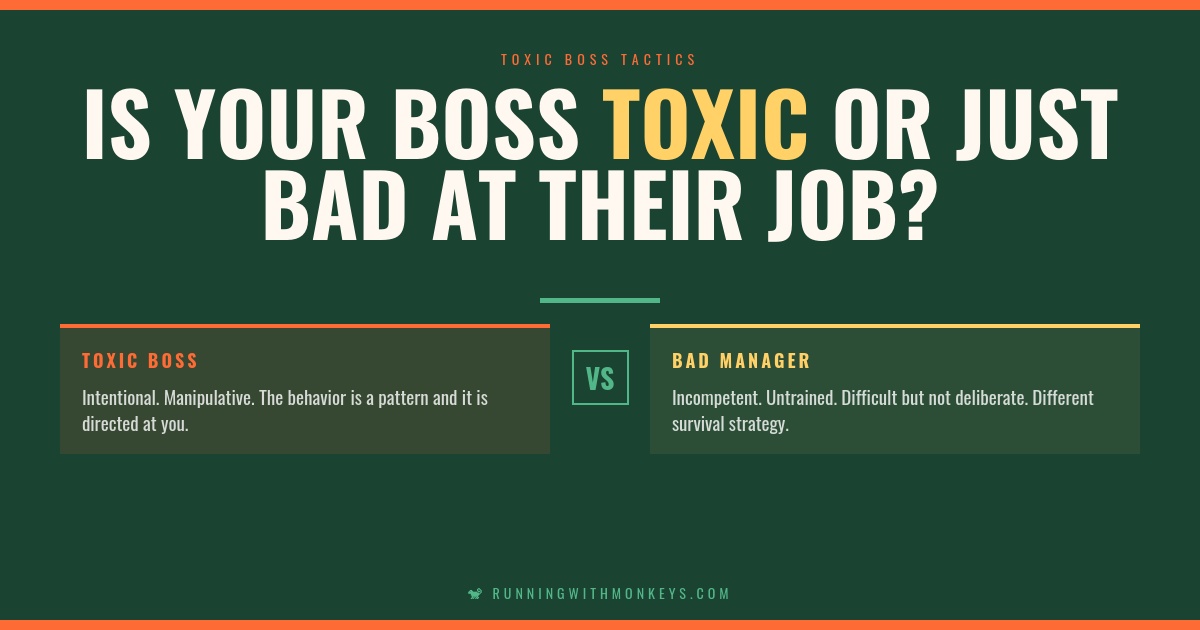
There is a meaningful difference between a toxic boss and a bad boss. And knowing which one you are dealing with changes everything about your survival strategy.
A bad boss forgets to give you feedback, schedules meetings that could have been emails, and genuinely has no idea how to develop the people on their team. They are frustrating. They cost you time and sanity. But they are not trying to hurt you.
A toxic boss is a different situation entirely.
A toxic boss takes credit for your work, sets you up to fail, isolates you from colleagues, and creates an environment where you are always off-balance. Whether it is intentional or not, the result is the same: you leave every interaction feeling worse than when you walked in.
Here is how to tell which one you have.
Signs You Have a Bad Boss
Bad bosses are usually pretty easy to spot once you know what you are looking for. The hallmarks are incompetence, not cruelty.
They give vague feedback. “This just needs to be better” is not feedback. Neither is “I will know it when I see it.” A bad boss often cannot articulate what good looks like because they have not thought it through themselves.
They are inconsistent, but randomly so. You never know what kind of mood they will be in. Not because they are strategically keeping you off-balance, but because they have no emotional regulation skills and they bring whatever they walked in with to the office.
They are reactive instead of proactive. Bad bosses manage by crisis. Nothing gets addressed until it is already a problem. Planning ahead is not in their vocabulary.
They play favorites, but openly and without shame. They might not even realize they are doing it.
Meetings are chaos. No agenda. No follow-up. No decisions made. Just everyone sitting in a room until someone mercifully says they have another call.
The good news about a bad boss: they are often coachable (if they want to be), or at least predictable enough that you can work around them.
Signs You Have a Toxic Boss
Toxic bosses are not just incompetent. They are harmful. And the patterns are usually deliberate, even if the boss would never admit it.
They take credit and assign blame. Your wins belong to them. Your failures belong entirely to you.
They undermine you in public. Whether it is a side comment in a meeting or a joke at your expense, they regularly chip away at your credibility in front of others.
They set you up to fail. Impossible deadlines. Unclear expectations. Resources withheld. Then confusion about why you did not deliver.
They use information as a weapon. You find out about changes after they happen. You are left out of meetings you should have been in. You are never quite sure what you do not know.
They gaslight you. “That is not what I said.” “You are being too sensitive.” “Nobody else has a problem with this.” If you regularly leave conversations questioning your own memory, pay attention to that.
You feel dread, not just stress. There is a difference between being busy and being scared to check your email. One is a workload problem. The other is a you-have-a-toxic-boss problem.
Why It Matters
If you have a bad boss, your strategy is about coping and compensating. You find workarounds. You document your wins. You manage up. You decide whether the job is worth the friction.
If you have a toxic boss, your strategy has to be different. You are not going to fix this with better communication or clearer expectations. Toxic bosses rarely change, and they often escalate when challenged.
Your strategy with a toxic boss is documentation, protection, and an exit plan.
What to Do Right Now
Whether you have a bad boss or a toxic one, there are things you can do immediately to protect yourself.
Start a work journal. Write down what was said, when, and who was present. Do this after every significant conversation or incident. You do not need to be formal about it. A dated entry in a notebook is enough to establish a pattern over time.
Know your rights. Most employees do not know what is and is not legal in the workplace. You do not need to be a lawyer to understand the basics.
Build your paper trail quietly. Forward key emails to a personal account. Keep copies of performance reviews. Save documentation of completed work.
Talk to someone outside your company. A friend, a therapist, a career coach. Toxic environments distort your perception of what is normal. Getting outside perspective is essential.
Recommended Reading
If you want to go deeper on understanding what you are dealing with, these are worth your time.
The Asshole Survival Guide by Robert Sutton is the most practical book I have found on navigating difficult people at work. It is research-based, genuinely funny in places, and full of concrete strategies for different types of difficult bosses and coworkers.
Surrounded by Idiots by Thomas Erikson is a breakdown of four personality types and why they clash. It will not fix your boss, but it will help you understand why your attempts to communicate keep failing and what to try instead.
Emotional Blackmail by Susan Forward is specifically about recognizing and responding to manipulation tactics. If your boss uses fear, obligation, or guilt to control you, this book is a revelation.
You are not imagining it. You are not being too sensitive. And you are not stuck.
Knowing what you are dealing with is the first step to figuring out what to do about it.
Subscribe below for weekly survival tactics, scripts, and reality checks delivered straight to your inbox.